
OpenAI and Jony Ive confirm prototype of first AI hardware device

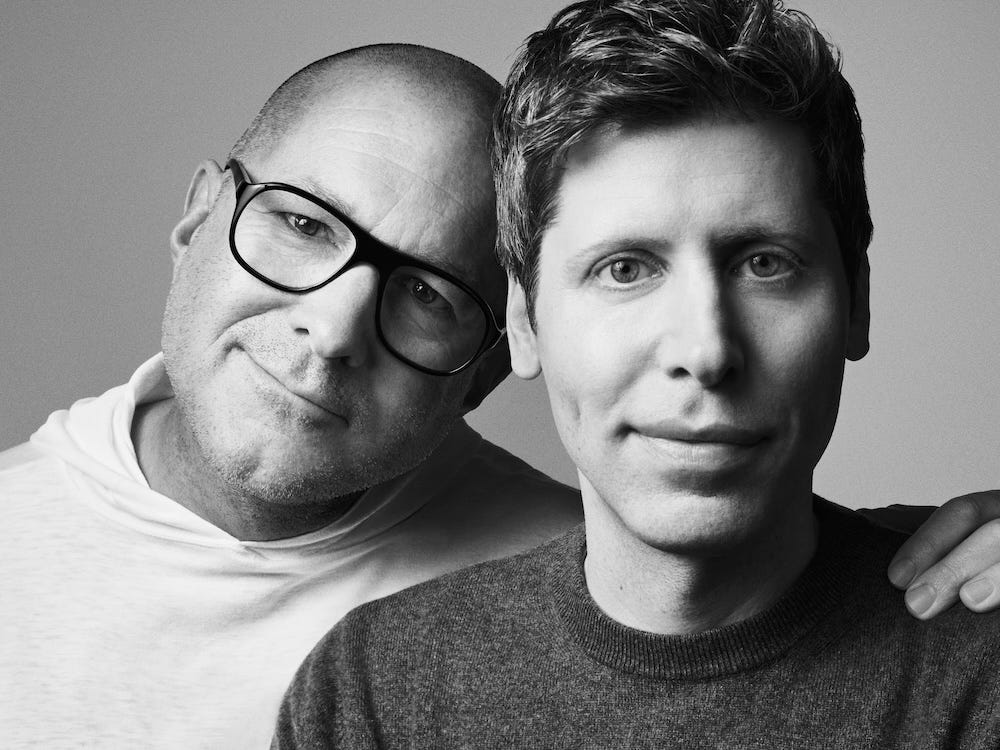
OpenAI CEO Sam Altman and legendary former Apple designer Jony Ive announced on Friday that they have completed a prototype for their highly anticipated AI hardware device, with a potential launch timeline of less than two years. The announcement came during a conversation with Laurene Powell Jobs at Emerson Collective’s ninth annual Demo Day in San Francisco.
Breaking new ground in AI hardware
Altman described the prototype as “jaw-droppingly good,” noting that the design came together “all of a sudden” after an extensive research and development process. During the onstage discussion, Ive expressed confidence that the product would be ready in “less than” two years, placing a potential launch as early as 2027.
“We’re going to make people smile. We’re going to make people feel joy. Whatever the product does, it has to do that.”
— Jony Ive
The device represents a significant departure from conventional consumer electronics. According to reports, it will be screenless, approximately the size of a smartphone, and designed to be “contextually aware” of users’ surroundings and activities. Altman characterized the design as “elegant, beautiful, and playful”—hallmarks of Ive’s work at Apple, where he shaped the aesthetics of the iPhone, iPad, and MacBook.
From acquisition to prototype
The announcement follows OpenAI’s $6.5 billion acquisition of io Products (Ive’s AI hardware startup) in May 2025, marking the company’s largest deal to date. OpenAI had previously held a 23% stake in io through a partnership agreement established in late 2024. Ive co-founded io in 2024 alongside former Apple colleagues Scott Cannon, Evans Hankey, and Tang Tan.
Under the arrangement, Ive has assumed “deep design and creative responsibilities across OpenAI and io,” while his independent design firm LoveFrom continues to operate separately. The 55-person io team has joined OpenAI to establish a new hardware division overseen by Peter Welinder.
A vision for “calmer” computing
Both Altman and Ive have emphasized that their device aims to create a fundamentally different relationship between humans and technology. During the Demo Day conversation, Altman compared the desired experience to the peace of “a cabin by a lake”—a stark contrast to the attention-demanding nature of smartphones and laptops.

The device is reportedly designed to be an “AI companion” that observes and understands its user’s environment without requiring the constant screen interaction that defines modern devices. Internal OpenAI communications have described the product as a potential “third core device” alongside a MacBook Pro and iPhone.
Altman acknowledged that while the iPhone, which Ive designed, represents “the crowning achievement of consumer products,” most current devices and applications fall short of that standard. The pair’s goal is to create something that encourages users to “wean off screens” and interact with technology more naturally.
Manufacturing and supply chain developments
Reports indicate that OpenAI has secured partnerships with major Apple suppliers to manufacture the device. Luxshare Precision, a primary contract manufacturer for iPhones and AirPods, has reportedly won the assembly contract for at least one OpenAI device. The company is also in discussions with Goertek, another Apple supplier, to provide components such as speaker modules.
The first batch of products is expected to launch commercially in late 2026 or early 2027. Altman has set an ambitious target of producing 100 million devices “faster than any company has ever shipped 100 million of something new before.”
Legal complications over branding
The venture has faced legal obstacles regarding its name. In June 2025, a startup called IYO Inc.—which develops AI hearing technology and emerged from Google’s X research lab—filed a trademark infringement lawsuit against OpenAI, Altman, Ive, and io Products. IYO claims it spent over $60 million and seven years developing its own screenless AI wearable and alleges that OpenAI representatives were aware of its brand through meetings and product demonstrations dating back to 2022.
A federal judge granted IYO a temporary restraining order in June, forcing OpenAI to remove all references to the “io” branding from its website. OpenAI has stated it disagrees with the complaint and is reviewing its options, with the company confirming that the trademark dispute has no bearing on the underlying acquisition or device development.
Competing in the AI hardware landscape
OpenAI’s hardware ambitions place it in competition with established tech giants also pursuing AI-native devices. Meta has found success with its Ray-Ban smart glasses, which have sold over two million units since 2023. Samsung recently unveiled its Galaxy XR extended reality headset, while Google has demonstrated prototype AI-enhanced glasses.


Previous attempts at dedicated AI devices have met with mixed results. The Humane AI Pin, backed by former Apple executives and Altman himself as an investor, struggled with battery life, overheating, and limited capabilities before being discontinued, with HP acquiring its assets for $116 million. The Rabbit R1 has achieved more modest success, selling over 100,000 units despite lukewarm reviews.
Looking ahead
The collaboration between Altman and Ive has drawn comparisons to the legendary partnership between Ive and Steve Jobs at Apple—a parallel that OpenAI appears to embrace. During the Demo Day conversation, Powell Jobs, the widow of Steve Jobs and founder of Emerson Collective, facilitated a discussion that touched on how the development process combined OpenAI’s research capabilities with Ive’s design philosophy.
Both executives have emphasized that extensive thought has gone into the implications of creating a computing device with comprehensive awareness capabilities, including privacy considerations—though specific details about how data privacy will be handled remain undisclosed.