
Japan advances missile deployment near Taiwan despite China's "extremely dangerous" warning

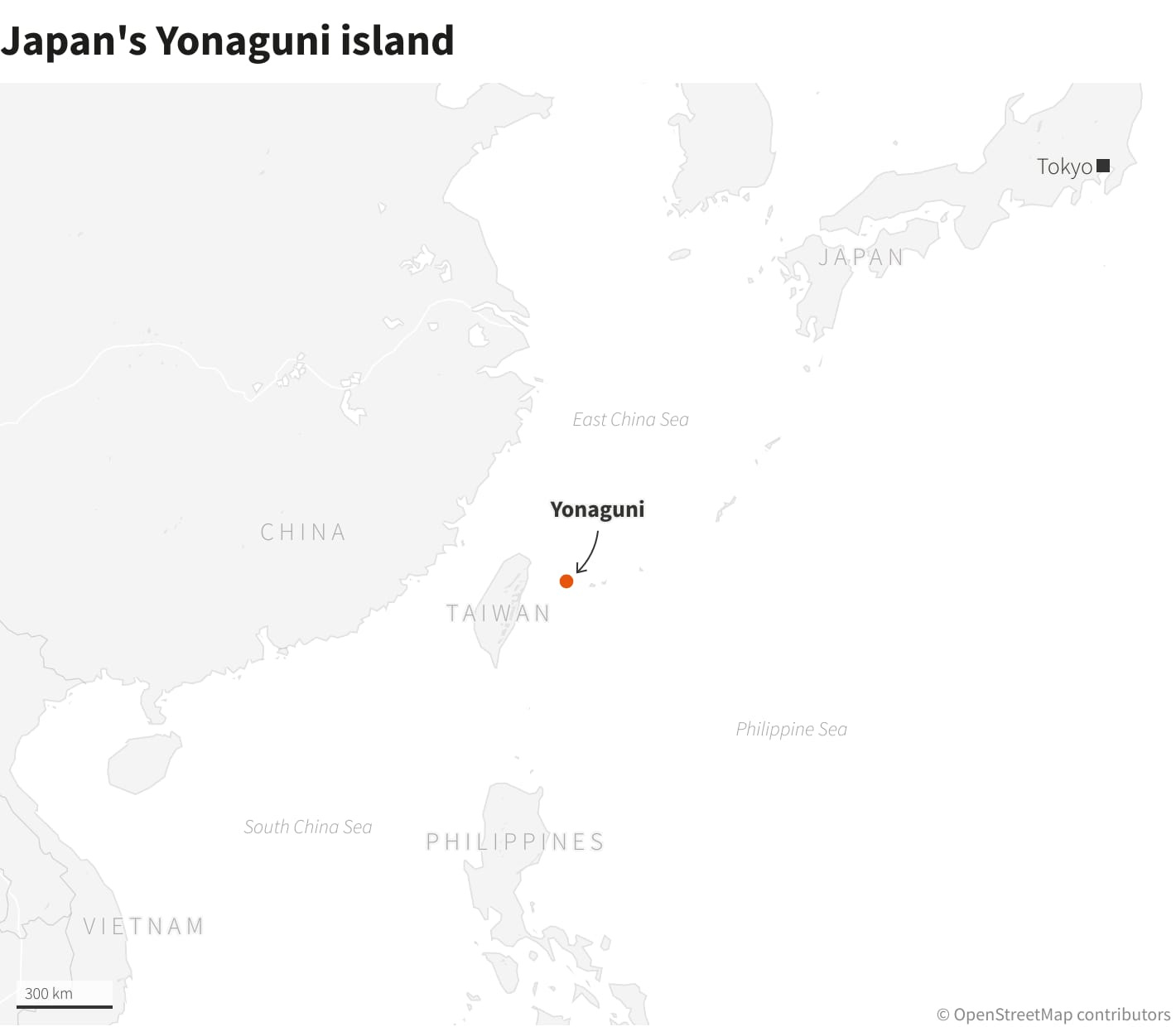
Japan’s Defense Minister Shinjiro Koizumi confirmed on Sunday that plans to deploy medium-range surface-to-air missiles on Yonaguni Island, just 110 kilometers from Taiwan, are “progressing steadily.” The announcement has drawn fierce condemnation from Beijing, which called the move “extremely dangerous” amid what has become the worst diplomatic crisis between the two nations in years.
The missile deployment
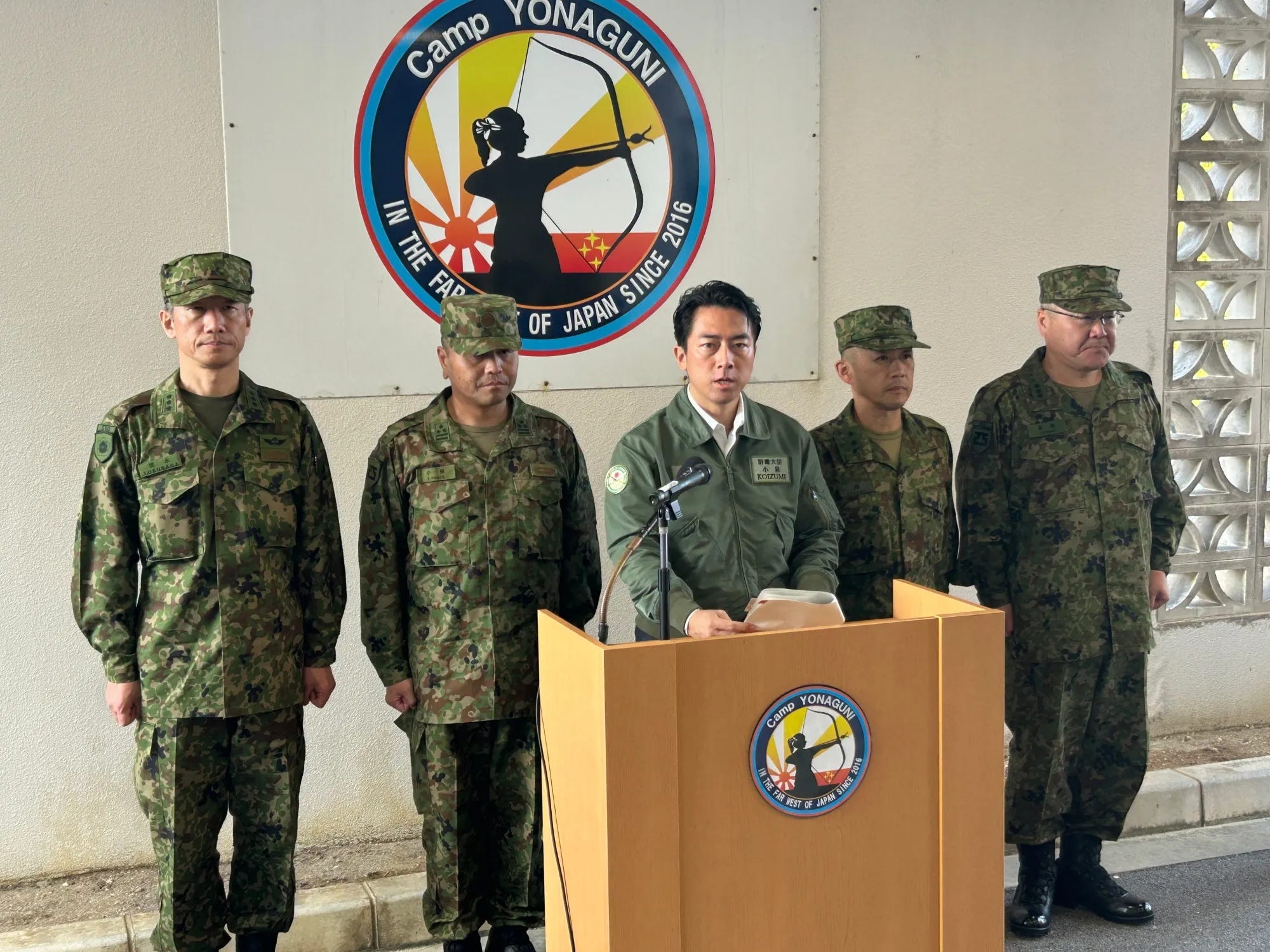
During his first visit to Yonaguni since assuming his post last month, Koizumi toured the Ground Self-Defense Force base and reaffirmed Tokyo’s commitment to fortifying its southwestern islands. The deployment will consist of Type 03 medium-range surface-to-air missiles, a domestically developed mobile air defense system capable of tracking up to 100 targets and engaging 12 simultaneously.
“The deployment can help reduce the likelihood of an armed attack on Japan. The view that it will heighten regional tensions is not accurate.”
— Defense Minister Shinjiro Koizumi
The Type 03 system, mounted on 8×8 trucks, employs phased-array radar technology and has a range of approximately 50-60 kilometers, which is far short of reaching Taiwan’s coastline or mainland China, but is designed to defend against incoming aircraft and missiles. Yonaguni has hosted a Ground Self-Defense Force base since 2016, which already includes surveillance radars and electronic warfare units, making it a frontline sentinel in any potential Taiwan Strait crisis.
China’s sharp rebuke
Chinese Foreign Ministry spokesperson Mao Ning described the missile deployment as “a deliberate attempt to create regional tension and provoke military confrontation” during a Monday press briefing in Beijing. She linked the military buildup directly to remarks made by Prime Minister Sanae Takaichi earlier this month, suggesting Japan could intervene militarily if China attacked Taiwan.
“Coupled with Prime Minister Sanae Takaichi’s erroneous remarks on Taiwan, this trend is extremely dangerous and warrants high vigilance from neighboring countries and the international community.”
— Chinese Foreign Ministry Spokesperson Mao Ning
The diplomatic crisis was sparked on November 7 when Takaichi, during a parliamentary session, stated that a Chinese naval blockade or military action against Taiwan involving “battleships and the use of force” could constitute “a survival-threatening situation” for Japan, potentially justifying the mobilization of the Self-Defense Forces under collective self-defense laws.
Economic retaliation escalates
Beijing has responded with a barrage of retaliatory measures beyond diplomatic protests. China has reimposed a ban on Japanese seafood imports, issued travel advisories warning citizens against visiting Japan, postponed Japanese film releases, and suspended a planned trilateral cultural ministers’ meeting with Japan and South Korea.
The economic fallout has been significant. Chinese travel platforms reportedly canceled 491,000 outbound tickets to Japan in the first three days following Beijing’s travel advisory, with Japanese retailers and hotels estimated to forgo approximately $893 million in revenue. Before the latest seafood ban, China accounted for more than one-fifth of Japan’s seafood exports.
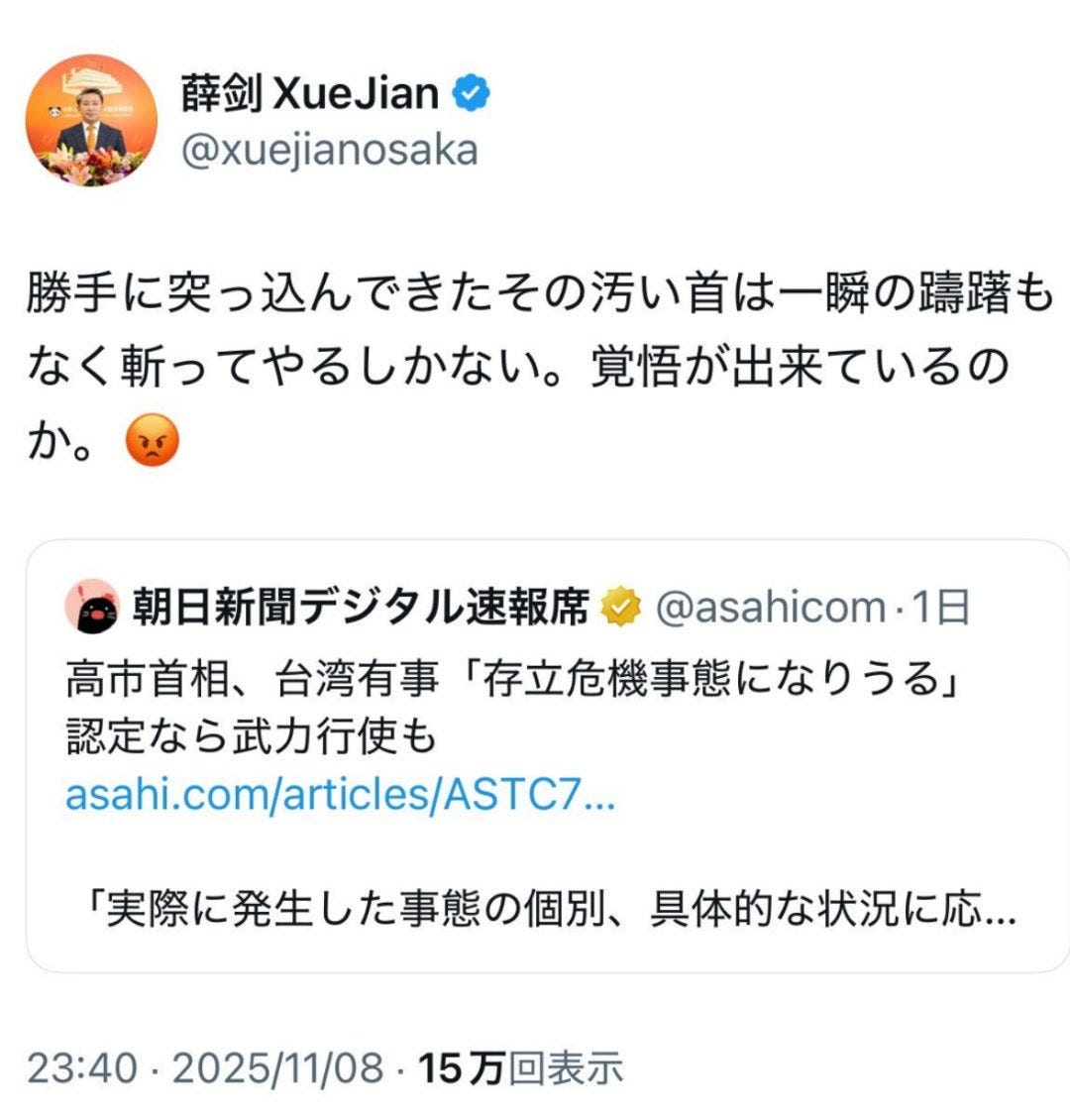
A Chinese diplomat in Osaka, Xue Jian, posted (then deleted) a threatening message on X (f.k.a. Twitter) referencing Takaichi, stating, “We have no choice but to cut off that dirty neck that has lunged at us without permission. Are you ready?” The post prompted Japan to summon the Chinese ambassador and demand his removal.
Dispute reaches the United Nations
China escalated the confrontation by taking the matter to the United Nations on Friday. Ambassador Fu Cong sent a letter to UN Secretary-General António Guterres condemning Takaichi’s remarks as “a grave violation of international law” and diplomatic norms.
“If Japan dares to attempt an armed intervention in the cross-Strait situation, it would be an act of aggression. China will resolutely exercise its right of self-defense under the UN Charter and international law and firmly defend its sovereignty and territorial integrity.”
— Chinese UN Ambassador Fu Cong
The letter, which will be circulated to all UN member states as an official General Assembly document, marked the first time since Japan’s defeat in 1945 that Beijing has accused a Japanese leader of expressing ambitions to intervene militarily in the Taiwan question.
G20 summit: No dialogue between leaders
The diplomatic freeze was on display at the G20 summit in South Africa this past weekend, where Prime Minister Takaichi and Chinese Premier Li Qiang attended sessions together but exchanged no words. Chinese Foreign Minister Wang Yi used the occasion to issue another stern warning, stating that Takaichi had sent a “shocking” wrong signal and “crossed a red line” that should never have been touched.
Takaichi told reporters following the summit that she had not arranged a meeting with Li but emphasized Japan remains “open to dialogue at various levels.” She stated, “There are concerns and issues between Japan and China. That’s why we should work to reduce them, understand each other and cooperate more. Of course, it is important for Japan to say what needs to be said to China.”
Taiwan voices support
Taiwan’s Deputy Foreign Minister Francois Wu expressed support for Japan’s missile deployment, telling legislators Monday that “Japan’s enhancement of its military capabilities is fundamentally beneficial for maintaining stability in the Taiwan Strait.” Wu emphasized Japan’s sovereign right to protect its territory, noting the nation “harbors no territorial ambitions or hostility towards Taiwan.”
Taiwan’s Foreign Ministry separately criticized China’s letter to the UN as containing “rude and unreasonable content” that “maliciously misrepresents historical facts” and “contravenes the UN Charter, which forbids the threat or use of force in international relations.”
Residents caught in the crossfire
Yonaguni, home to approximately 1,700 residents and known primarily as a diving destination famous for hammerhead sharks, has found itself at the epicenter of great power tensions. The island’s strategic position—Japan’s westernmost point, situated between Taiwan and the disputed Senkaku/Diaoyu Islands—has transformed it from a quiet backwater into a critical military outpost.
Local reaction remains divided. While Mayor Kenichi Itokazu supports military expansion and has advocated for additional troop deployments, some residents express unease. Shopkeeper Takako Ueno told reporters, “Being at the epicenter of this situation is incredibly stressful for the residents. I dread the thought of this picturesque island becoming a battleground.”
In 2022, during Chinese military exercises following then-U.S. House Speaker Nancy Pelosi’s visit to Taiwan, a ballistic missile landed just 80 kilometers from Yonaguni while local fishing vessels were operating nearby—a stark reminder of the real risks facing the island’s inhabitants.
Strategic implications
The deployment represents Japan’s broader “southwestern shift” in military strategy, accelerating defense enhancements near Taiwan amid what Tokyo describes as “the most severe and complex security environment since the end of World War II.” The move comes as U.S. Defense Secretary Pete Hegseth recently called Japan “indispensable” in the face of Chinese aggression, with both nations agreeing to accelerate joint development and production of missiles.
For Beijing, the timing is particularly provocative given Takaichi’s explicit linking of Taiwan’s security to Japan’s own survival—a departure from the strategic ambiguity maintained by previous Japanese leaders. China continues to demand Tokyo retract Takaichi’s statements, warning of further consequences if Japan refuses.
As the 80th anniversary of Japan’s defeat in World War II approaches, Beijing has increasingly referenced Tokyo’s wartime offenses while criticizing its neighbor, framing the dispute not merely as a policy disagreement but as a challenge to the post-war international order itself.